
 331 Followers



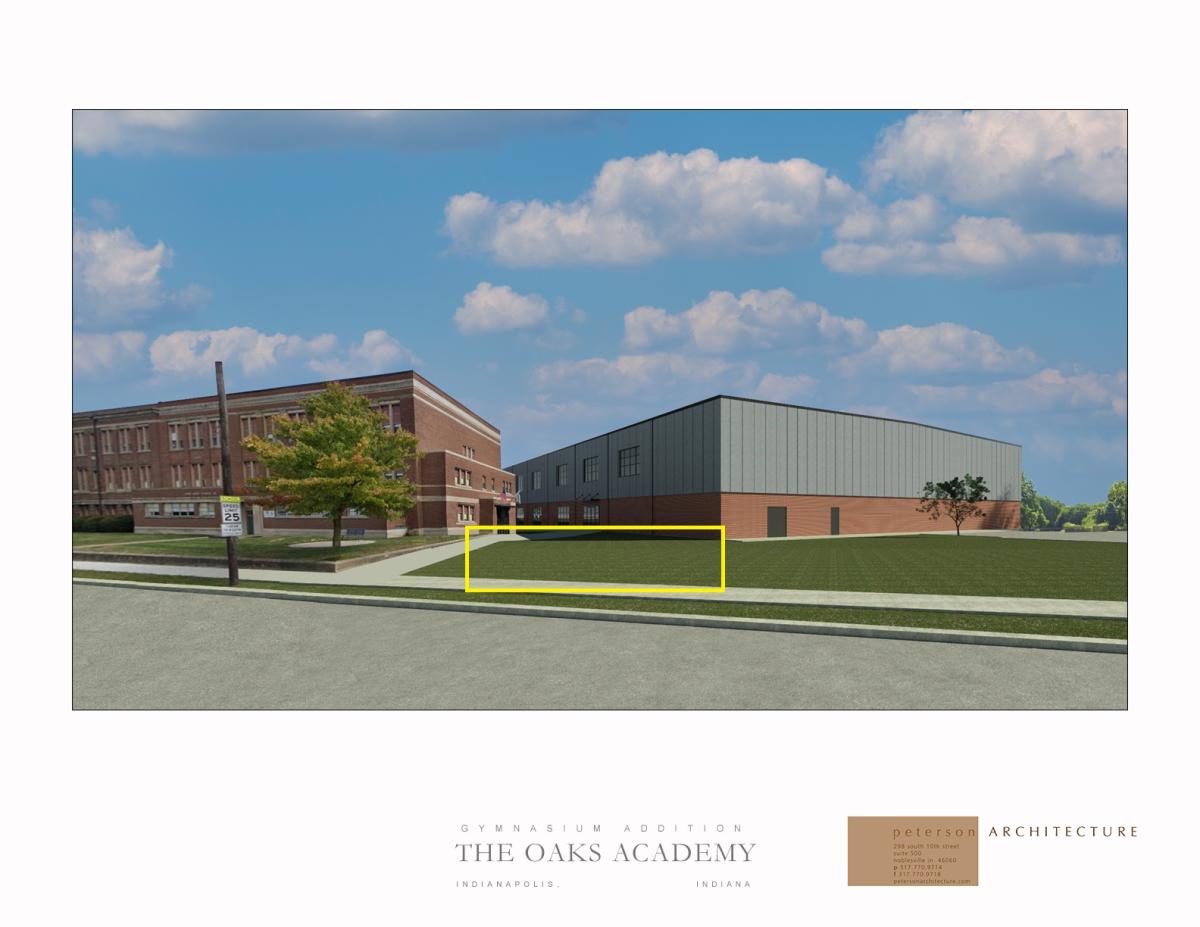
The Harrison Center is seeking entries for a public art project at Oaks Academy Middle School, located on the historic School 26 campus, made possible by the Indiana Landmarks Black Preservation Program. This campus has expanded to incorporate the site of the former King and King Funeral Home. The Oaks Academy seeks to honor that legacy. To be considered, entries must be artwork that incorporates the history and cultural significance of the King and King Funeral Home, its context, and impact.
History and Context
Martindale is a historic Black neighborhood in Indianapolis, northeast of downtown. The rootedness and vibrance of this community is where King and King was for many years. The Oaks Academy, a classical Christian private school, operates in the historical building of IPS School 26. Opening in 1901, it was among the first public schools in Indianapolis for Black children during segregation. Despite the racism and discrimination at the time, School 26 was known for its strong academics, community focus, and skills training. It would later establish a special education program for Black children with disabilities and a public library for Black residents, known as the Paul Laurence Dunbar Library. It was once the largest elementary school in Indiana, with 1,480 students. Blocks away from the school are many historic churches, including St. John’s Missionary Baptist Church, which was nationally significant for its community and civil rights work under the leadership of Dr. Andrew J. Brown during the Civil Rights era. Martin Luther King would stay in Martindale when visiting Indianapolis and spoke at St. John's. Dr. Brown was honored by the change of Martindale Ave to Dr. Andrew J. Brown Ave. Martindale is also home to the historic Frederick Douglass Park, which had a swimming pool and golf course for Black residents who were barred from other city parks. A variety of churches, businesses, schools, and recreational spaces were and are located in this community.
The location of the King and King was constructed before 1876 as an Italianate, two-story frame house. The King and King Funeral Home was founded in 1931 by a married couple, Thomas E.J. King and Nettie Scott King. During the Jim Crow era in America, there was “economic business risk” for white morticians to see Black families. Black funeral homes were vital businesses for communities. The first King and King Funeral Home was located at 2023 Columbia Ave, but it later moved to its current location, 1503 Columbia, in 1935. They were known for their quality service and quickly had a robust operation, including an ambulance service. The Kings were committed to their community through their business and personal lives. Thomas King was known for being hospitable and giving, from buying ice cream for kids in the neighborhood to offering extra help during the Great Depression. This was especially true with the Universal Negro Improvement Association (UNIA). The UNIA was founded by Marcus Garvey in 1914. Its mission was about Black independence, pride, and economic ownership. Although many are familiar with the Madison Square Garden demonstration and the UNIA's presence in New York City, it is less well-known that the organization has a presence in other states. The prominence of the NAACP and Garvey’s deportation led to its decline by the 1930s. But local community chapters still existed like in Indianapolis. Thomas King was elected as president of the Indianapolis UNIA in 1929. This chapter thrived despite Garvey’s decline. They met at Liberty Hall on Indiana Ave. and had a large following. Thomas King was also a life member of the NAACP and helped start the Indianapolis junior branch. He was also involved in the Good Samaritan Rescue Mission, the Eastside Better Business and Civic League, and the East End Civic Club. The Kings were members of New Bethel Baptist Church in Martindale. Thomas King died in 1951. Nettie King and her brother Paul continued the King and King business.
Mrs. King took a stand against the Citizens School Committee (CSC), which used their power to slate only white school board candidates, even though 25% of the district were Black students. It slated only one candidate who became the first Black school board member in 1955. And when his term was ending, they did not try to slate him or another Black person in 1959. A rival committee, the Better School Committee (BSC), was founded in response to the slow integration of IPS and the CSC’s alleged discrimination and lack of accountability. They slated a Black candidate in 1959, and the CSC started attacking them in response. Nettie King resigned in an open letter, openly criticizing the CSC for refusing to be tokenized. Although the BSC’s candidate did not win, their challenge brought more people to the polls and helped initiate a change in school board candidates.
As the city changed, businesses faced new challenges, such as the decision to build Interstate 70 through Martindale. I-70 came just south of King and King. The Interstate displaced many residents, split the community, and created a noisy, permanent presence. Nettie King died in 1977, and the funeral home changed hands three times, with its last site being the Ellis Mortuary, before it was sold to Oaks Academy, its neighbor.
King and King was more than a funeral home. It was a part of a community and run by a family who cared deeply about their Black community and neighbors.
See details regarding entries, deadlines, etc. below:
- Artists who have currently or previously lived in Indianapolis are encouraged to apply.
- We are accepting all mediums for both interior and exterior applications.
- Harrison Center reserves the right to decline artwork based on its suitability for all audiences. The Oaks Academy will have final approval of the content of the work.
- Submit JPEG images and any supporting documents necessary to communicate your vision (labeled: lastname_title) by Friday, January 30th, 2026 emailed to polklore@harrisoncenter.org. Submitted images may be a finished product or concept. Images of previous work and references are required.
If you would like to visit the potential locations of the art installation please notify the Harrison Center and they will coordinate a visit at one of the following times: Monday, January 5th from 1:00-2:00pm, Wednesday, January 14th from 11:00-12:00pm, and Tuesday, January 20th from 9:00-10:00am.
- Artists who are selected to participate in the show will be notified by Tuesday, February 17, 2026.
- Selected public art will become the property of the Oaks Academy.
- Community engagement is a necessary part of the project. The Harrison Center will facilitate opportunities for the artist to hear from community members and residents of Martindale-Brightwood. This will be discussed once the artist is selected.
- Artist award is $10,000, payable 50% upon sign of contract and 50% upon satisfactory installation of art.
- Artwork must be presented professionally. It must ensure compliance with applicable building codes, permits, and safety regulations for the Oaks Academy Middle School campus.
If your work is selected for the public art installation, it must be completed and installed by October 31, 2026.
Questions? Contact Kenedy Manuel at kmanuel@harrisoncenter.org.
IMPORTANT NOTE: PLEASE SEARCH THE LINK BELOW TO SEE THE POTENTIAL LOCATIONS OF THE INSTALLATION. THIS IS ONLY HELPFUL IF ONE IS SUBMITTING AN EXTERIOR (OUTDOOR) INSTALLATION.
https://drive.google.com/drive/folders/1zYwJe5VX4y9o3jxo_qU9tUQAIjACQE2A?usp=sharing
 11 events
Indianapolis, Indiana, United States
11 events
Indianapolis, Indiana, United States  View profile
 Message
 Follow
 Following
